Custom tunes for MTBs
Share
Why MTB Manufacturers Use Custom Tunes for Their Rear Suspensions
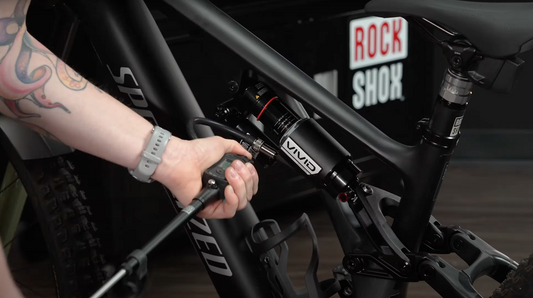
Mountain bike manufacturers today develop frames and suspension systems as a closed, integrated system. The rear suspension, kinematics, and shock cannot be considered independently of each other. For this reason, many manufacturers rely on custom tunes for their shocks, meaning a specially adapted shock setup for that specific frame.
The most important factor is the kinematics of the rear suspension. Depending on the system, e.g., VPP, DW Link, or four-bar linkage, with varying leverage ratios, progression, and anti-squat values, very different forces act on the shock. A custom tune allows the manufacturer to precisely match compression and rebound to the leverage curve, so that the rear suspension responds sensitively but still offers sufficient support.
Another point is the balance between efficiency and performance. Modern trail and enduro bikes should pedal efficiently uphill and provide maximum traction downhill. By adjusting the low-speed compression, bobbing during pedaling can be reduced without compromising sensitivity to small bumps. Precisely this fine-tuning is possible with a custom tune.
The end progression and bottom-out resistance also play a central role. Manufacturers can use volume spacers, shock curves, or special shim stacks to ensure that the rear suspension provides more support in the last third of its travel – tailored to the bike's intended use, whether trail, enduro, or downhill.
Last but not least, it's about brand identity and ride feel. Many manufacturers pursue a clear philosophy of how their bikes should feel – for example, "firm and sporty" or "sensitive and planted." A custom tune helps to consistently implement this desired ride feel and stand out from the competition.
In summary, a custom tune allows for maximizing the potential of the rear suspension kinematics. Instead of viewing the shock as a compromise, it becomes an integral part of the frame design – with measurable advantages in traction, control, efficiency, and riding enjoyment.